THE IF4IT NOUNZ Data Compiler
IF4IT NOUNZ is a data compiler that uses the concept of Data Driven Synthesis (DDS) to automatically build (i.e., synthesize) other important data, information, and knowledge management constructs like reified relationship tuples, massive static websites, taxonomies, ontologies, and much more.
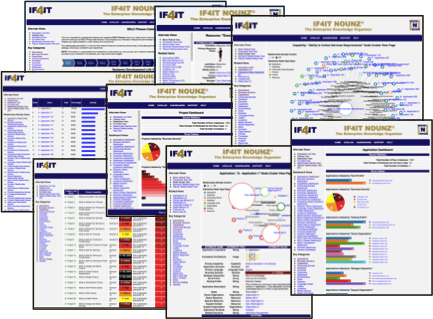
What is NOUNZ?
NOUNZ is a knowledge management tool (KM) that was built by the IF4IT to help pre-compile data into a data graph consisting of various types of nodes and reified relationships. Once in this form, the NOUNZ data compiler can synthesize other constructs (e.g., reified relationships, taxonomies, ontologies, catalogs, large-scale read-only wikis, and much more).
It helps enterprises model and better understand their business and IT organization, while simultaneously helping to simplify Master Data Management (MDM) and Data Governance (DG). Because it can generate massive read only wikis, it also is a powerful knowledge management (KM) tool.
What are the benefits of a NOUNZ model?
Synthesized Interactive Visualizations: Unlike static HTML files, NOUNZ compiled models allow stakeholders to see and explore their data and its relationships using both simple and complex, highly interactive, visualizations that most enterprise simply cannot afford to build and maintain, themselves. It is through such visualizations that stakeholders can better see, explore, and understand their data and information.
Comprehensiveness: NOUNZ generates one model that combines other traditional models (Architecture Models, Business Analysis Models, Configuration Management Databases / CMDBs, etc.).
Scaling: NOUNZ allows both vertical and horizontal scaling.
-
Vertical Scaling: You can build massive inter-linked websites and data constructs that ensure no dead links. Imagine automatically creating millions of highly inter-linked web pages that can be published at-will. Changes can simply and quickly be handled through recompilation and the results of every compilation can easily be versioned, archived and compared manually or with automation.
-
Horizontal Scaling: Unlike other modeling tools that only allow you to work with one model, NOUNZ allows you to build and work with as many models as you want. This makes it easy to also do things like build and compare side-by-side changes to existing models (e.g., current state vs. future state comparisons).
Speed: NOUNZ generates in minutes-to-days what would normally take an enterprise many weeks-to-months to generate with traditional tools and technologies.
Cost Savings: Because NOUNZ is faster and because it collapses numerous different models into one enterprise model, your enterprise saves on 1) technology costs and 2) labor costs.
What is Data-Driven Compilation (DDC)?
NOUNZ uses a concept called Data-Driven Compilation (DDC) (a.k.a. Data-Driven Synthesis (DDS)) to compile your enterprise model into prepared graph constructs (e.g., nodes and relationships) that allow you to better answer questions about your data using natural language. It does this by using rules you create that help the compiler scour your data for traits and Semantic Relationships that are impossible to manually extract due to volume and time. What would normally take an organization many months and many people to do can be achieved in minutes to hours.
What is an Enterprise Model (EM)?
An EM is a structure that contains data about the enterprise. Examples of the types of data that go into such models include but are not limited to:
-
Applications
-
Capabilities & Functions
-
Catalogs
-
Contracts
-
Customers
-
Data Integrations
-
Data Stores
-
Facilities
-
Government Agencies
-
Leases
-
Licenses
-
Market Sectors
-
Market Segments
-
Offerings
-
Organizations
-
Partners
-
Policies
-
Procedures
-
Processes
-
Products
-
Regulations
-
Roadmaps
-
Roles & Responsibilities
-
Services
-
Stakeholders
-
Standards
-
Strategies
-
Value Chains
-
Vendors
-
Etc.
The power comes not from just the data instances/records that act as the millions of Nodes in the model but also from the many millions of descriptive Semantic Relationships (SRs) between all the above data. The problem with traditional tools is that humans are required to create and manage the relationships between all the instances in the above data sets. This makes scaling and changing difficult, slow, and expensive.
How does NOUNZ construct and represent Enterprise Models?
NOUNZ generates constructs like data driven websites and many precompiled data structures that can be loaded into many different systems (e.g., the enterprise Service Catalog or Configuration Management Databases (CMDBs).
A Data Driven Website is a static HTML website that is structured in the form of static HTML documents, which are interlinked with each other through a predefined IF4IT designed structural Ontology. You can traverse the model on a file system for limited stakeholder sharing or publish it to a web server for broader stakeholder sharing.
The backbone of the inter-linked data records is the easily configurable generation of reified relationships in the form of N-tuples that don’t just link nodes together but, instead, describe how they’re linked together in the form of meaningful Semantic Relationships (SRs). In a standard Wiki, pages elements are linked together via standard HTML links that are 0-tuples, containing no descriptive data. NOUNZ reified Semantic Relationships include a fully described source, a fully described target, and a fully described predicate that binds them, always in minimum form of a 5-tuple that makes it easy to represent each relationship in simple, descriptive, semantic sentence. Imagine millions of descriptive sentences that are 1) automatically generated and 2) bind your data records in a manner that makes understanding what’s related to any node simple and clear.
What stakeholders leverage and use NOUNZ models?
NOUNZ covers a broad range of uses for multiple enterprise stakeholders. Examples include but are not limited to:
-
Enterprise Architects (EAs) & Solutions Architects (SAs) - Architecture Models.
-
Business Analysis & Technical Analysts, - Data Analysis Models (DAMs).
-
Operations staff & Call Center staff, - CMDBs.
-
Data Governance (DG) & Master Data Management (MDM) - Data Models, Taxonomies, and Ontologies.
-
Knowledge Managers – Enterprise Knowledge Models (EKMs).