Product Thinking in IT: Treating IT Systems, Platforms, and Services Like Products
Applying product management principles and practices to internal IT systems, platforms, and services—ownership, lifecycle management, and continuous improvement.
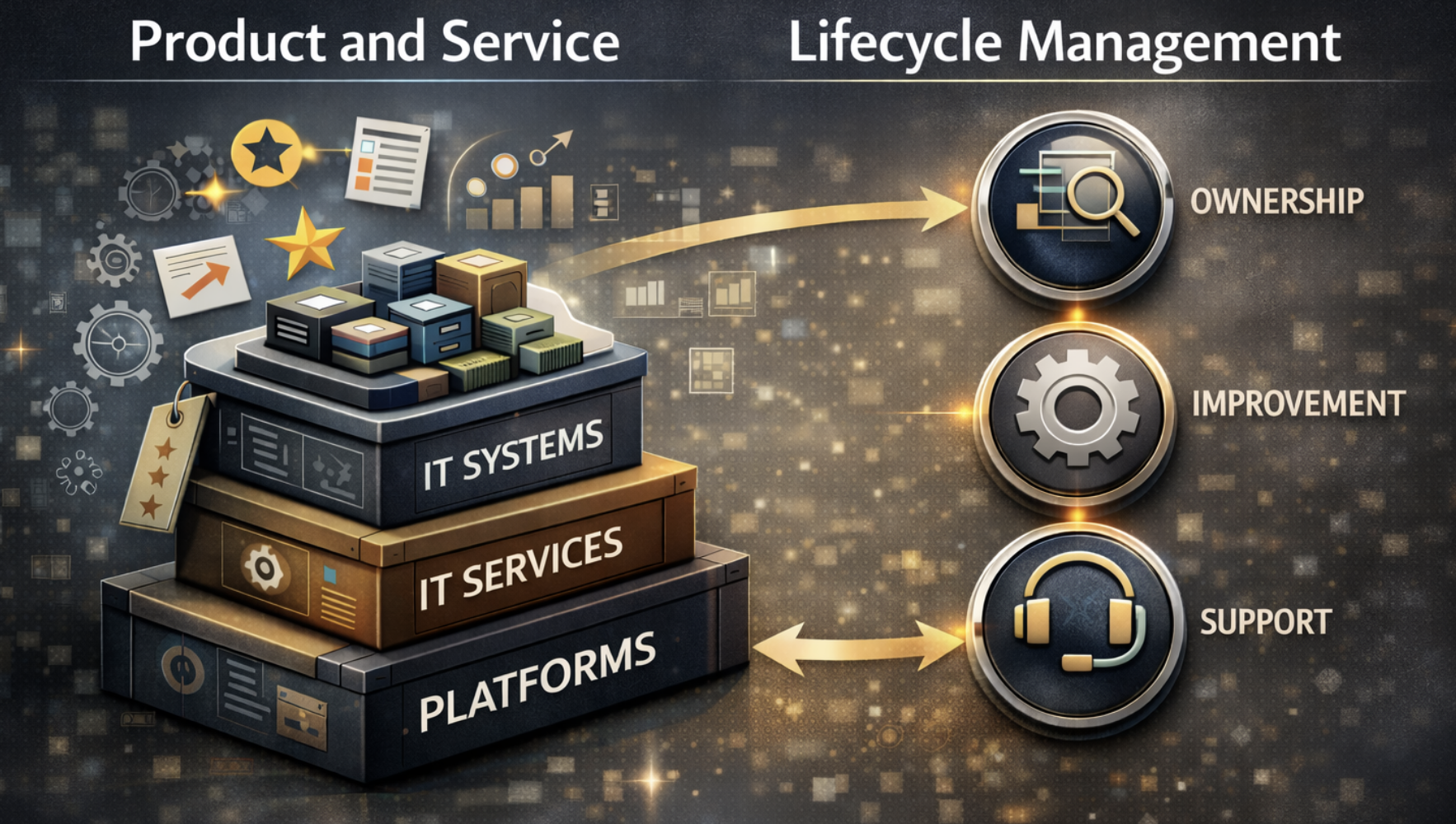
Overview
For most of its history, IT has been run like a construction business. A business unit identifies a need, IT scopes a project, a budget is approved, a team is assembled, and the work begins. When the project delivers—when the system goes live, the platform is deployed, the integration is wired up—the team disbands, the budget closes, and the work is declared done.
Except it is never done.
The system still needs to be maintained. Users encounter problems. The business evolves and new requirements emerge. Security vulnerabilities surface. Performance degrades. And because nobody owns the thing anymore—because the project closed and the team moved on—every subsequent need becomes a new project: a new scope, a new budget request, a new fight for resources, a new round of the same conversations.
This is the project model of IT, and it produces exactly the kind of outcomes organizations have come to expect: systems that are technically delivered but never truly finished, platforms that drift out of alignment with business needs, and services that nobody owns and everyone complains about.
Product thinking offers a different model. It treats IT systems, platforms, and services not as projects to be completed but as products to be owned, evolved, and continuously improved—with dedicated teams, defined roadmaps, explicit metrics, and an ongoing accountability to the users and business capabilities they serve.
The shift is not just organizational. It is philosophical. And for IT organizations serious about delivering lasting business value, it is one of the most important changes they can make.
The Project Model and Why It Fails
The project model is optimized for delivery. It asks: what needs to be built, by when, and for how much? These are sensible questions for constructing a building or launching a marketing campaign. They are the wrong questions for managing a payroll system, a customer data platform, or an enterprise identity service that hundreds of employees depend on every day.
It treats completion as success. In a project model, going live is the finish line. Budget is consumed, teams rotate off, and success is measured by whether the deliverable was produced on time and within scope. But the value of an IT system is not realized at go-live—it is realized over years of use. A CRM system that launches on schedule but is never adopted, never optimized for how users actually work, and never updated as the sales process evolves has technically succeeded as a project and failed as an investment.
It creates orphaned systems. Every organization has them: applications delivered by a project team, handed to an underfunded operations group, and slowly fell behind. The HR self-service portal still running on an unsupported platform. The reporting tool built for a business process that no longer exists. The middleware integration nobody fully understands but everyone is afraid to touch.
It misaligns funding with reality. Project budgets fund construction. They do not fund the ongoing investment required to keep a system relevant, secure, and improving. The result is a slow accumulation of technical debt, deferred improvements, and mounting risk—until a crisis forces a new project to fix what the last project left behind.

What Product Thinking Actually Means
Product thinking reframes the question. Instead of asking what needs to be built, it asks what capability the business needs, who depends on it, and how to make it continuously better.
In a product model, an IT system, platform, or service is treated like a product with a defined user base, a dedicated owner, a backlog of improvements, a set of metrics that indicate health and value, and a lifecycle that spans years—not quarters.
This is not a new concept in the software industry. Product management as a discipline has shaped how companies like Salesforce, Spotify, and Amazon build and evolve their offerings. What is newer—and still underappreciated—is the application of those same principles and practices to internal IT. Internal IT products operate under conditions that differ meaningfully from external products. There is no market competition to signal when a product is falling behind. Users cannot switch to a competitor. These differences do not invalidate product thinking. They shape how it must be applied.
The Four Pillars of Product Thinking in IT
1. Ownership: Someone Is Always Accountable
The most fundamental shift in product thinking is the introduction of clear, persistent ownership. Every IT system, platform, and service needs a named owner—a product owner or product manager—who carries full accountability for the product across its entire scope: its improvement, its operations, and its support. Not one of those dimensions. All three.
A system administrator is accountable for keeping a system running. A project manager is accountable for delivering a defined scope. A help desk team is accountable for resolving tickets. In the traditional IT model, these responsibilities are distributed across separate teams—each accountable for their piece, and nobody accountable for the whole. The product owner changes that. They are the single point of accountability for everything the product is and does.
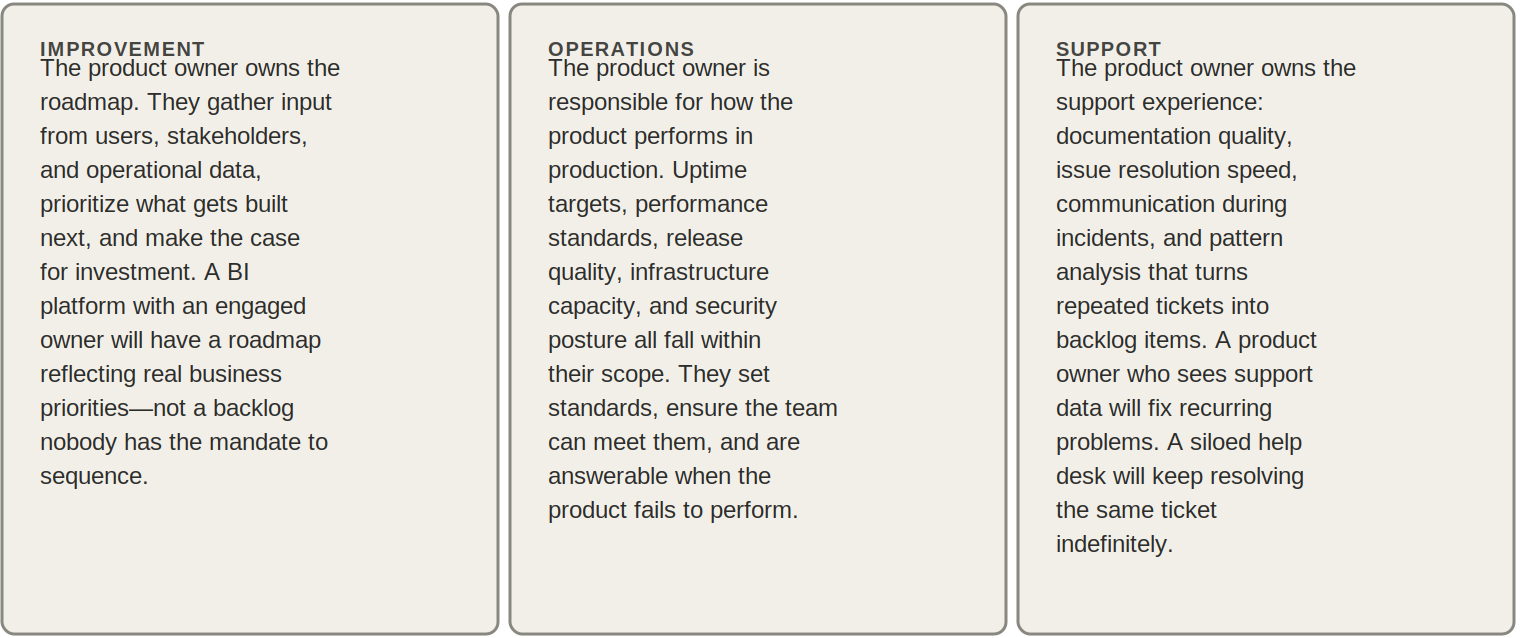
The reason unified accountability matters is that the three dimensions are deeply interdependent. Deferred operational investment creates support burden. Unresolved support patterns reveal improvement opportunities. Improvements that land poorly create new operational and support demand. An owner who sees all three sees the full picture. An organization that splits them across separate teams creates gaps—and in those gaps, IT systems stagnate.
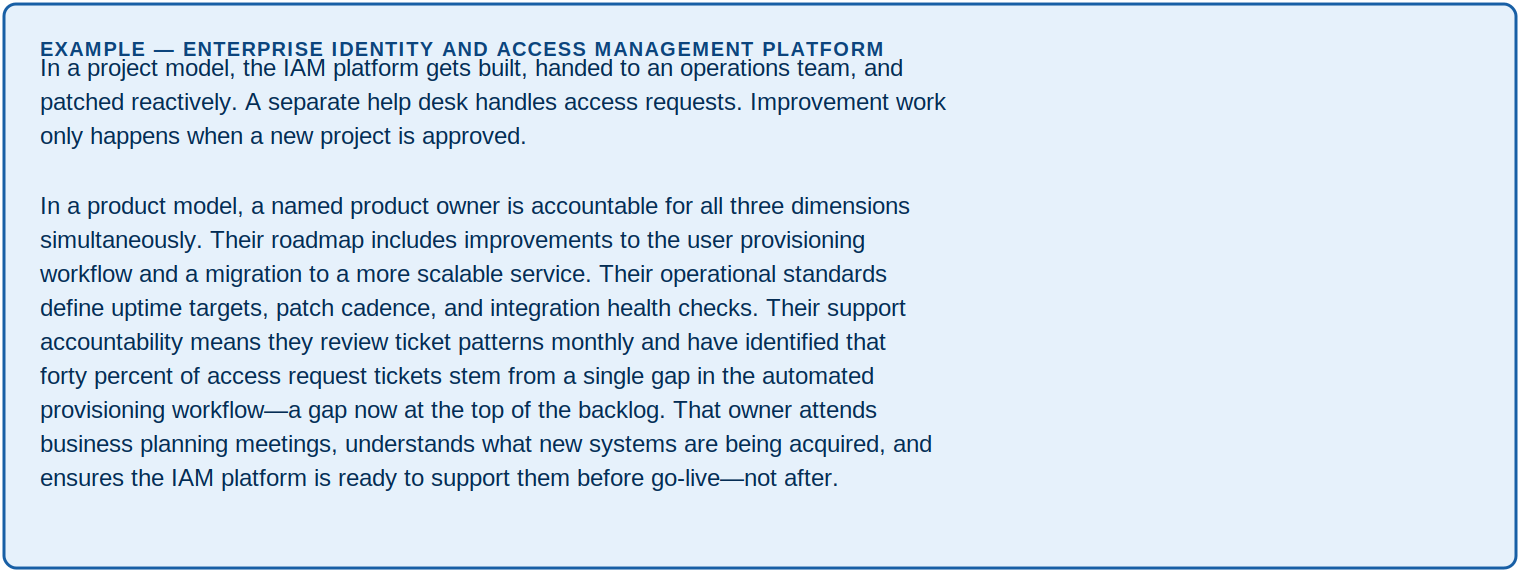
The same unified accountability applies to a data warehousing platform, an enterprise service bus, a customer-facing self-service portal, a payroll system, and the IT service catalog itself. These are products. They each deserve an owner accountable not just for what gets built, but for how it runs and how it is experienced—every day, across its entire lifecycle.
2. Lifecycle Management: Products Evolve, They Do Not Expire
In a product model, IT systems have a lifecycle: introduction, growth, maturity, and eventually retirement—with deliberate management at every stage. A data analytics platform in its growth phase needs investment in new capabilities and user adoption. The same platform in maturity needs investment in performance and cost optimization. A legacy ERP module approaching end of life needs a managed migration path—not reactive maintenance until it finally breaks.
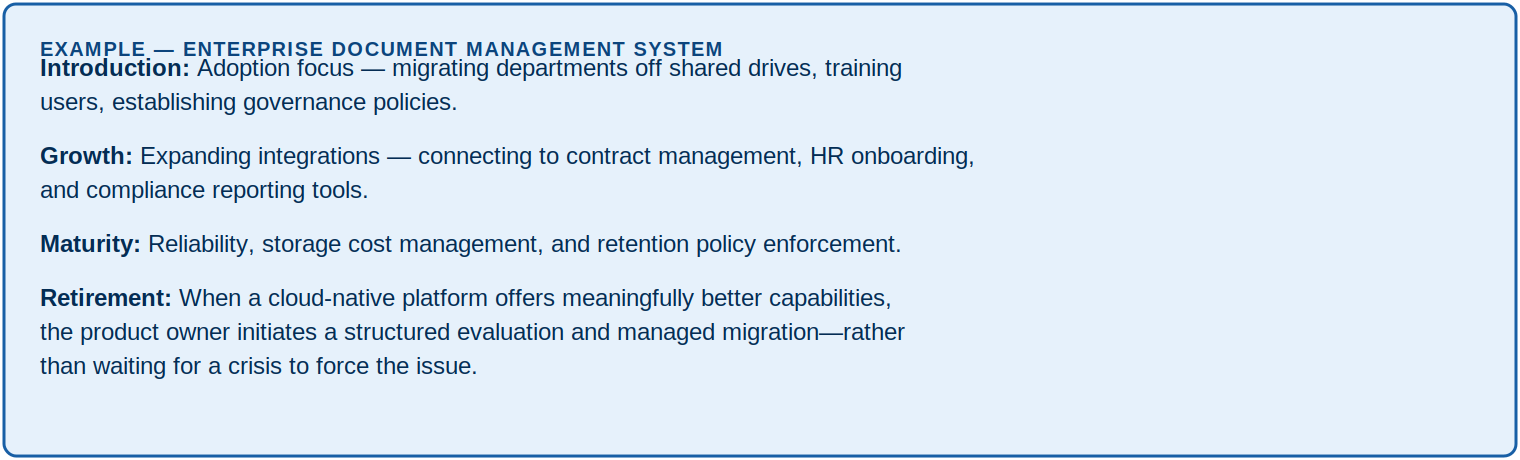
Lifecycle management also governs the retirement of systems that should no longer exist. Organizations accumulate technical debt partly because nobody is ever accountable for deciding when a system's useful life has ended. A product model makes that decision explicit: every product has an owner, and every owner is responsible for assessing whether continued investment is justified.
3. Continuous Improvement: The Backlog Is Never Empty
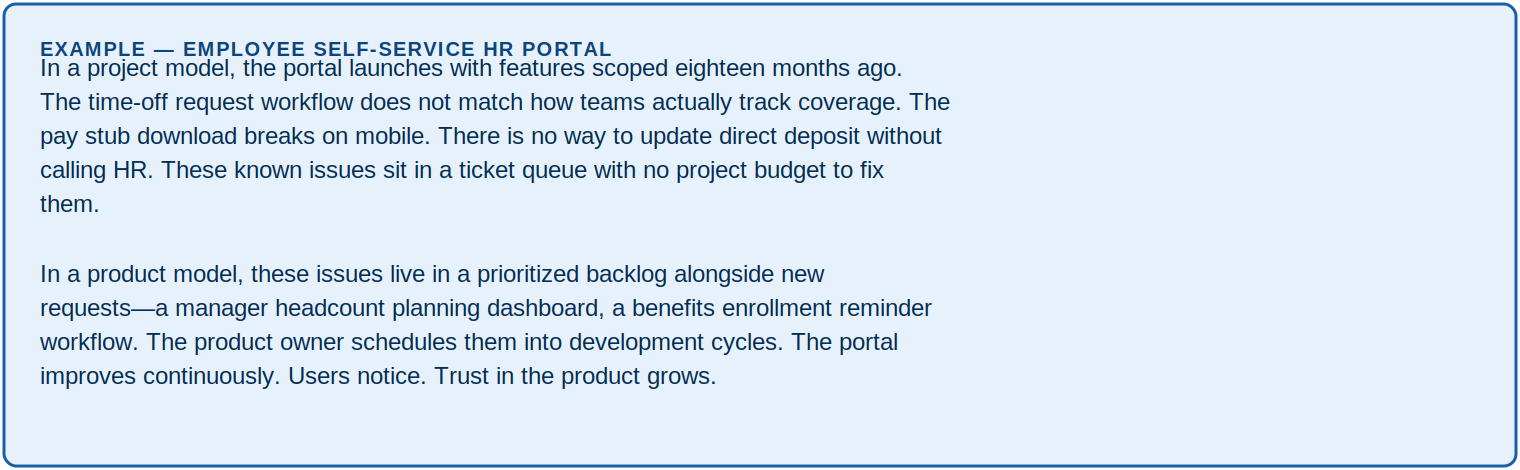
A product backlog is an ordered, living list of improvements, fixes, enhancements, and investigations that guides ongoing investment. In a project model, requirements are gathered at the start and frozen. The result is a system that reflects what the business needed when the project started—not what it needs now.
4. Metrics: Measuring Value, Not Just Output
Project metrics measure delivery: on time, on budget, within scope. Product metrics measure value: adoption, reliability, user satisfaction, and business impact. A project can be delivered on time and within budget while producing a system that nobody uses, that fails under load, or that costs more to support than it saves. Project metrics call that a success. Product metrics call it a failure.
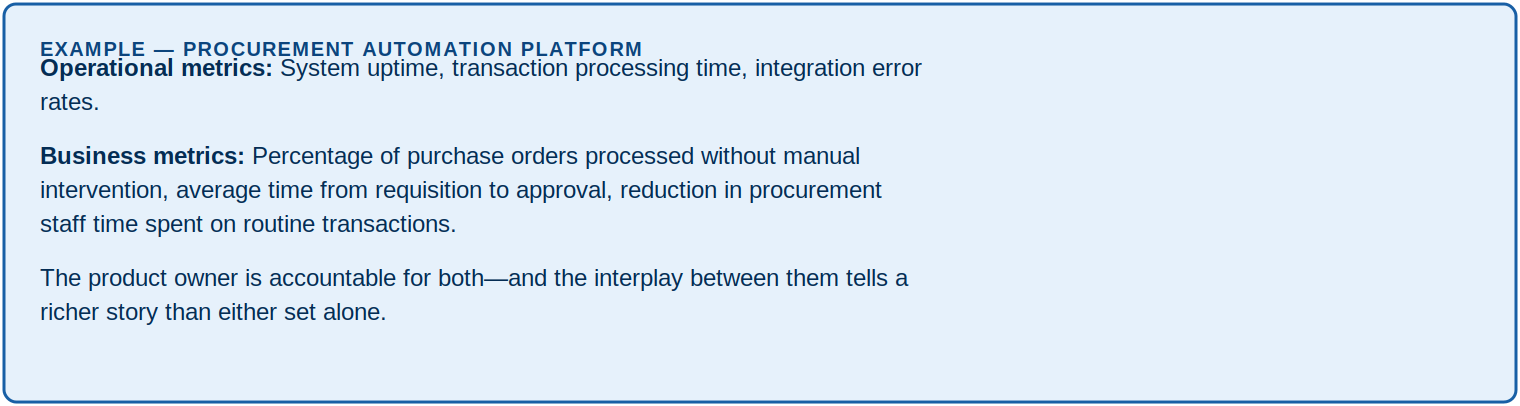
Effective IT product metrics operate at two levels. Operational metrics track health: availability, response time, error rates, support ticket volume, and mean time to resolution. Business metrics track value: process cycle time reduction, cost avoidance, user adoption rates, and the business outcomes that depend on the capability.
Designing the Product Portfolio: Grouping, Clustering, and Multi-Product Ownership
The product model, applied without discipline, creates a new problem: too many products. If every system, integration, service, and platform gets its own named owner, its own backlog, its own metrics review, and its own governance cadence, the administrative weight of managing that portfolio quickly becomes unsustainable. IT leaders who try to stand up product ownership at scale without thinking carefully about portfolio design will find themselves with dozens of thinly owned products—each receiving just enough attention to claim ownership but not enough to actually improve.
This is one of the most underaddressed practical challenges in adopting product thinking, and it deserves honest treatment.
Grouping Smaller Items into Coherent Product Clusters
The most effective response to portfolio sprawl is deliberate grouping—organizing smaller systems, platforms, and services into logical product clusters that share a common owner, a unified backlog, and a coherent identity in the eyes of their users. Items should be clustered because they serve the same users, operate within the same business domain, or depend on each other technically—not simply because they are small. Grouping by domain produces an owner who genuinely understands their users and can make principled tradeoffs across a set of related capabilities.
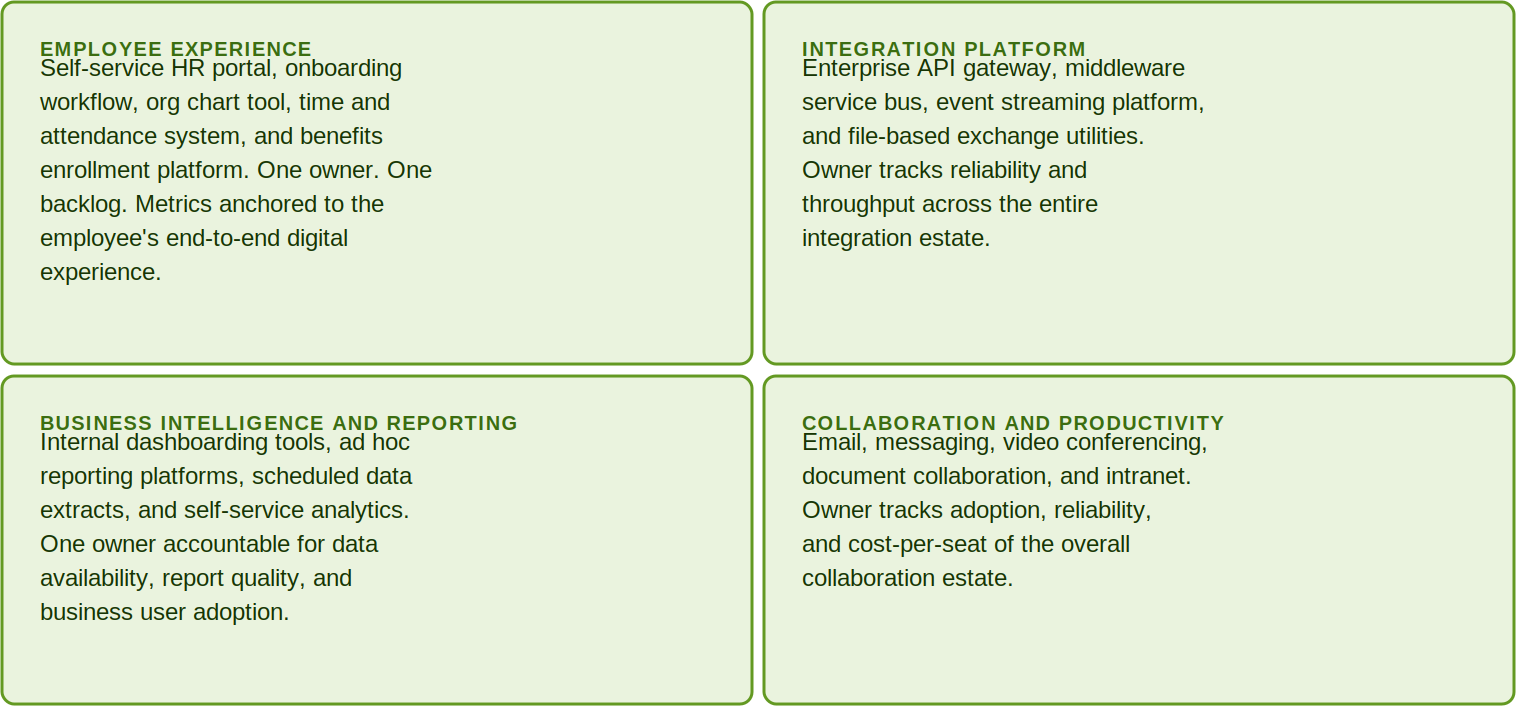
These clusters do not eliminate the individual systems within them. They add a layer of coherent ownership above them—ensuring that someone is accountable for the domain as a whole, not just for the individual components in isolation.
When Clusters Should Split
Grouping is a starting point, not a permanent structure. A product cluster can grow—in user demand, in technical complexity, in strategic importance—to the point where a single owner can no longer give it the attention it deserves. The signal to split is usually one of three things: the backlog for one component is consistently crowding out the others, the operational demands of one system are consuming a disproportionate share of the owner's time, or a component has grown strategically significant enough to warrant its own dedicated investment conversation with business leadership.
An Employee Experience cluster might eventually split when the onboarding and offboarding workflow becomes complex enough—spanning HR, IT, facilities, and legal—to justify a dedicated owner and team. This mirrors the catch-all logic in a well-designed IT service catalog: broad coverage first, specialization as it is earned.
Multi-Product Ownership: When It Works and When It Does Not
A single product owner carrying responsibility for more than one product is common, often necessary, and potentially dangerous—depending on what is being owned and how actively each product needs to be managed.
Multi-product ownership works reasonably well when the products involved are in a mature, stable state: well-established systems with low rates of change, manageable support volumes, and predictable operational demands. A product owner who carries two or three mature products—a stable payroll integration, a settled document management system, and a well-adopted collaboration platform—can stay genuinely informed about all of them without any one being neglected.
Multi-product ownership breaks down when one or more products are in active development, undergoing significant operational change, or generating high support demand. An owner simultaneously managing a major platform migration, responding to elevated support volume on a second product, and trying to advance the roadmap on a third is not owning three products—they are triaging three products.
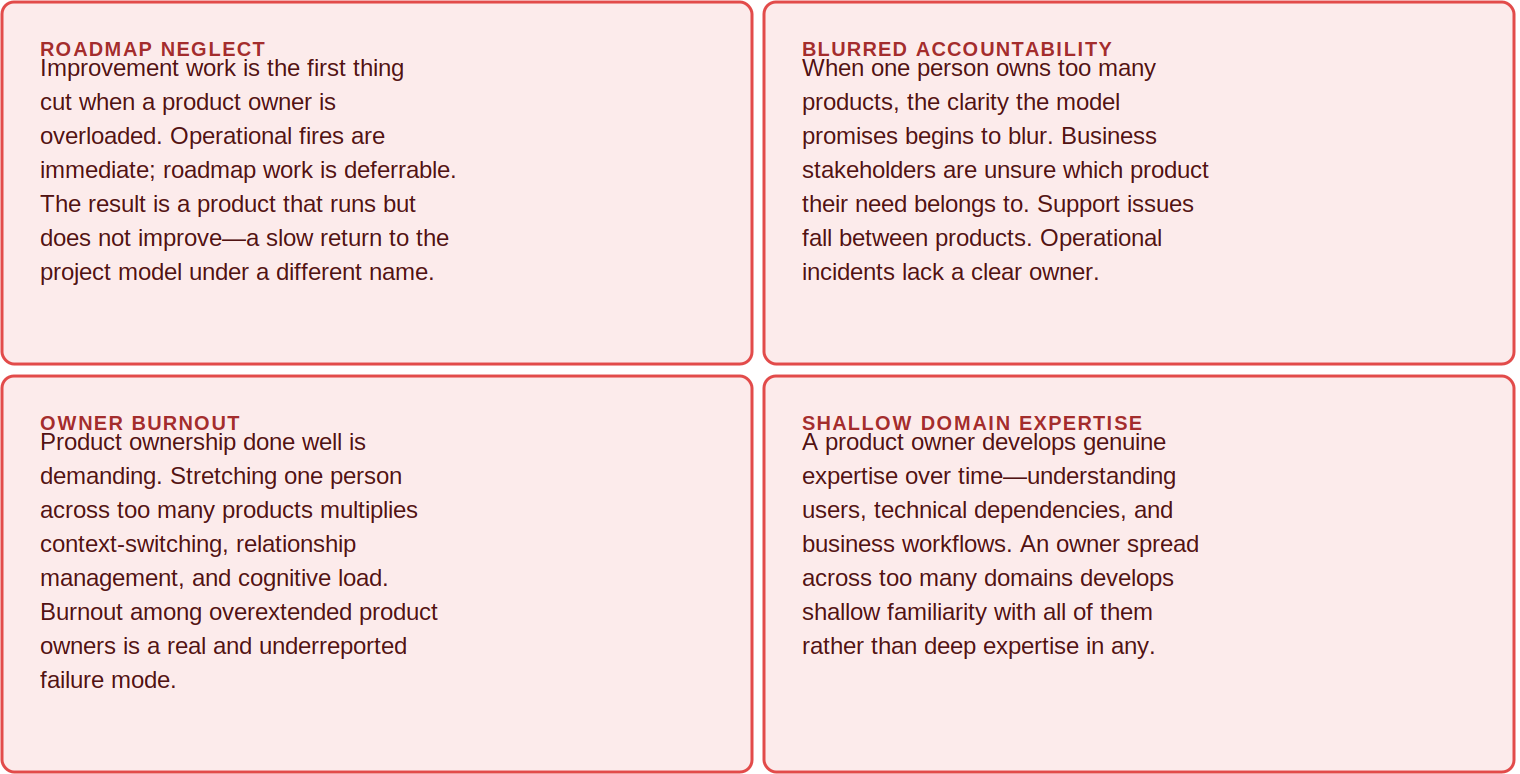
A practical ceiling for multi-product ownership is roughly one actively evolving product and two to three stable ones. Beyond that, the risks above begin to manifest. Organizations that consistently exceed that ceiling have a portfolio design problem, not a staffing problem: the solution is better-designed clusters, not more products assigned to the same person.
The Project-to-Product Transition: What It Actually Takes
Funding models must change. Product teams need persistent, stable funding—not project-by-project budget approvals. Many organizations have moved toward capacity-based funding: each product team receives an annual allocation covering both operational and improvement work, with a lightweight governance process for major investments above a threshold.
Team structures must change. A product model requires stable, cross-functional teams that stay with a product across its lifecycle. This runs against the grain of traditional IT staffing, where specialists are pooled and allocated to projects as needed.
Governance must adapt. Traditional IT governance is designed around projects: stage gates, approval bodies, and delivery milestones. Product governance is focused on strategic alignment, investment allocation across the product portfolio, and ongoing performance accountability.
Not everything becomes a product. Infrastructure components like network switches, server hardware, and basic storage do not benefit meaningfully from product ownership models. One-time integrations, regulatory compliance projects, and infrastructure migrations are still best managed as projects.

Where to Start
The most practical starting point is to identify three to five IT capabilities that are clearly operating as orphaned systems or chronically underserved services—and assign explicit product ownership to them. Good candidates have identifiable business users who depend on them daily, an accumulated backlog of known improvements that never get addressed, and funding that is reactive rather than strategic.
Common examples include the enterprise intranet, the IT service catalog, the employee onboarding and offboarding workflow, the business intelligence and reporting platform, and the API gateway that connects internal and external systems.
For each, the first step is straightforward: name an owner, document the current user base and key use cases, establish a simple backlog, identify three to five metrics that indicate health and value across improvement, operations, and support—and schedule a quarterly review. That is not a complete product model. But it is the beginning of one, and it is enough to demonstrate the difference that persistent, unified ownership makes.
The Deeper Argument
Product thinking in IT is ultimately an argument about accountability. The project model distributes accountability across a series of temporary teams and approved budgets. When something goes wrong—when the system underperforms, when the platform falls behind, when the service fails users—there is no single owner. There is a project that was delivered, a ticket queue that is backlogged, and a budget cycle that has not opened yet.
The product model concentrates accountability. An owner is responsible for the system or platform or service—not for a delivery milestone, but for its improvement, its operations, and its support, continuously, across its entire useful life. That owner can be held to metrics, can advocate for investment, can make tradeoff decisions, and can be a genuine partner to the business units who depend on what they manage.
This is not a small change. It requires IT organizations to think differently about how they are structured, how they are funded, and what they are ultimately accountable for. But it produces something the project model cannot: IT capabilities that get better over time, because someone is always responsible for making them better.
That is what product thinking delivers. And for organizations that are serious about IT being a strategic asset rather than a service utility, it is not optional—it is the direction of travel.
Published by IF4IT.com — The International Foundation for Information Technology